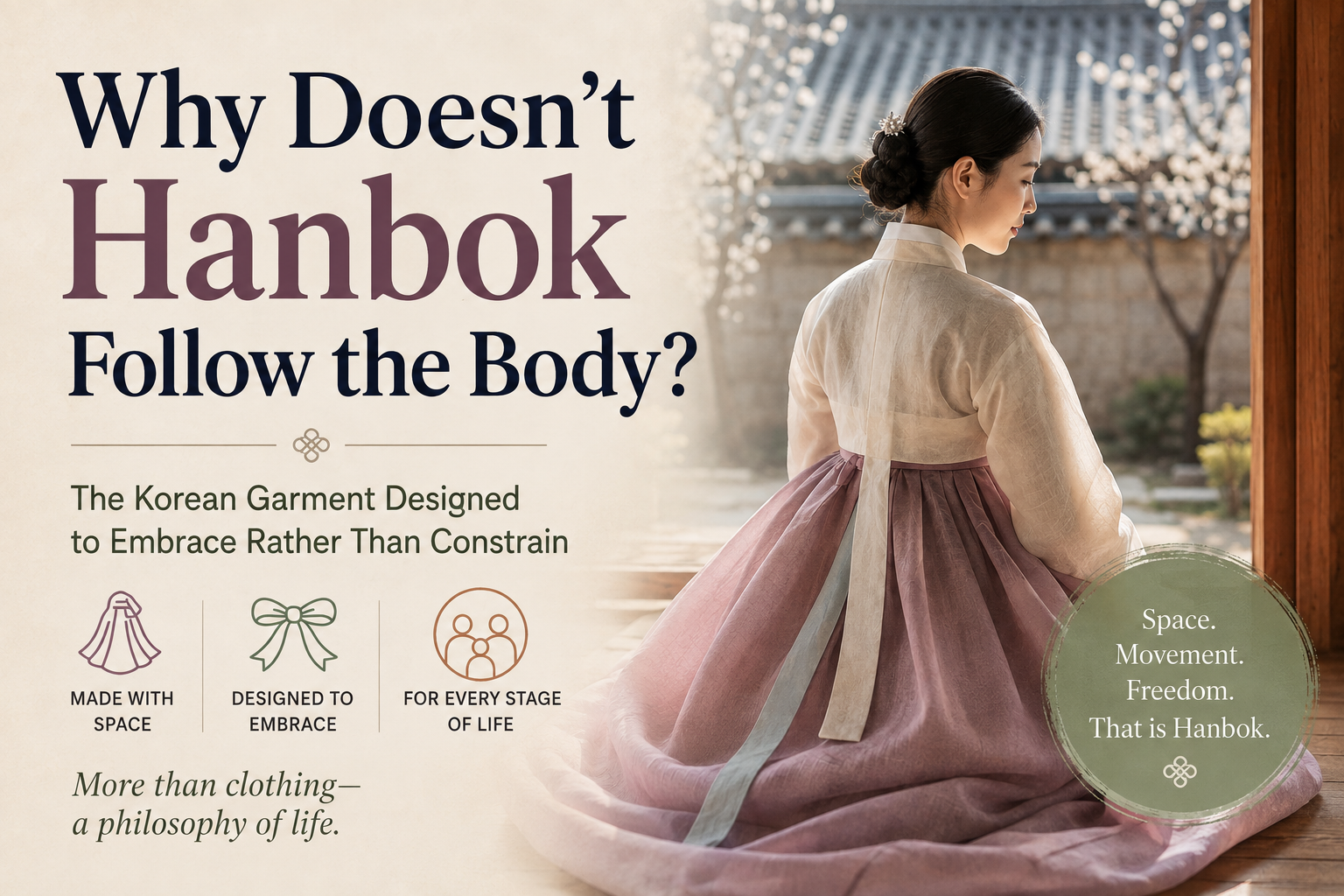
Why Doesn’t Hanbok Follow the Body?
The Korean Garment Designed to Embrace Rather Than Constrain
Prologue: The Last Stitch
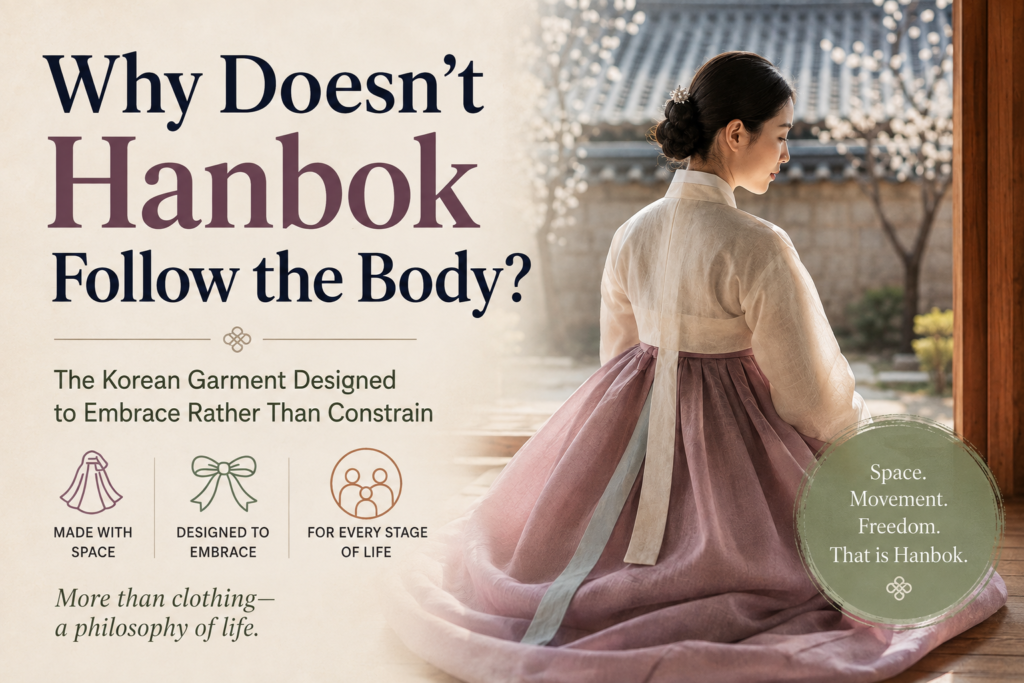
There was once a mother who stayed up through the night, sewing her daughter’s wedding hanbok.
With the fabric resting across her lap, she pushed her needle through the cloth, one careful stitch at a time. There was no rushing. A hanbok was never meant to be made in a single day.
Whenever the gentle curve beneath the sleeve—the baerae—didn’t look quite right, she patiently pulled out the thread and began again.
Watching her work, the daughter finally asked,
“Mother, wouldn’t it be easier if you simply cut it to fit the body?”
The mother smiled.
“Clothes aren’t meant to fit the body,” she said. “They’re meant to embrace it.”
At the time, the daughter didn’t fully understand.
She simply watched as the colorful ribbons of the hanbok slowly came to life beneath her mother’s hands.
A few days later, she wore the hanbok for her wedding ceremony.
As she gently tied the ribbons across her chest, something unexpected happened.
The fabric never pulled against her body.
Instead, it moved with her.
For the first time, she began to understand what her mother had meant.
Part One :
A Garment Made with Space, Not Lines
Many Western garments are built by following the body’s contours.
They shape the waist, define the shoulders, and emphasize the silhouette.
In many ways, the clothing determines the outline of the body.
Hanbok begins with a very different question.
“How can clothing rest on the body without interrupting the way it naturally moves?”
If Western tailoring often asks how clothing can reveal the body’s shape, hanbok first asks how the body can move with the greatest freedom.
Its construction is surprisingly simple.
Traditional hanbok is cut largely from flat, straight pieces of fabric.
Yet the moment those straight lines meet a living person, they become soft curves.
The baerae, the graceful curve beneath the sleeve, follows the movement of the arm.
The full skirt flows like water with every step.
Rather than clinging tightly to the body, hanbok always leaves space.
That empty space is not an accident.
It is the very heart of the garment.
Because of the room between fabric and skin, a person can sit comfortably, bow deeply, breathe freely, and move naturally.
The clothing does not confine the person.
Instead, it is within that space that the person becomes free.
Even its colors carry a quiet philosophy.
The five traditional colors of Korea—blue, white, red, black, and yellow—are more than decoration.
They reflect harmony with nature and the balance of the five elements in traditional Korean thought.
In garments such as the colorful saekdong jacket, each color stands beside the others without trying to overpower them.
None competes for attention.
Together, they create harmony.
The same philosophy can be seen in the garment itself.
Seen hanging on a rack, a hanbok may appear almost oversized. Only when someone begins to move does its true design reveal itself.
Part Two : The Power of Clothing That Doesn’t Confine
Why doesn’t hanbok reveal the body’s shape?
The answer isn’t a lack of tailoring skill.
It’s a different way of thinking about people.
Clothes made to fit the body perfectly capture a single moment in time.
But they also imprison the body within that moment.
As the years pass and the body changes, the garment no longer belongs to the person who wears it.
Hanbok chooses the opposite path.
Its generous silhouette, long ribbons, and softly flowing skirt welcome the body’s changes as naturally as the changing seasons.
Rather than preserving one perfect version of a person, hanbok makes room for every stage of life.
When you walk in hanbok, the fabric follows a heartbeat behind you.
It doesn’t pull you forward.
It simply follows your movement with quiet respect.
Each step sends the skirt gently into motion.
Each lift of the arm sets the sleeves dancing in the air.
The space—and even the slight delay—between the person and the garment is not emptiness.
It is kindness intentionally woven into the design.
⸻
Part Three : A Garment That Embraces Generations
Today, hanbok is most often worn on special occasions—Lunar New Year, weddings, milestone birthdays, and other meaningful celebrations.
Yet the warmth within the garment has never disappeared.
On New Year’s morning, children bow to their elders wearing colorful saekdong jackets.
Sometimes the sleeves are a little too long.
Sometimes the clothes are a little too big.
No one minds.
Those extra inches quietly leave room for the child who is still growing.
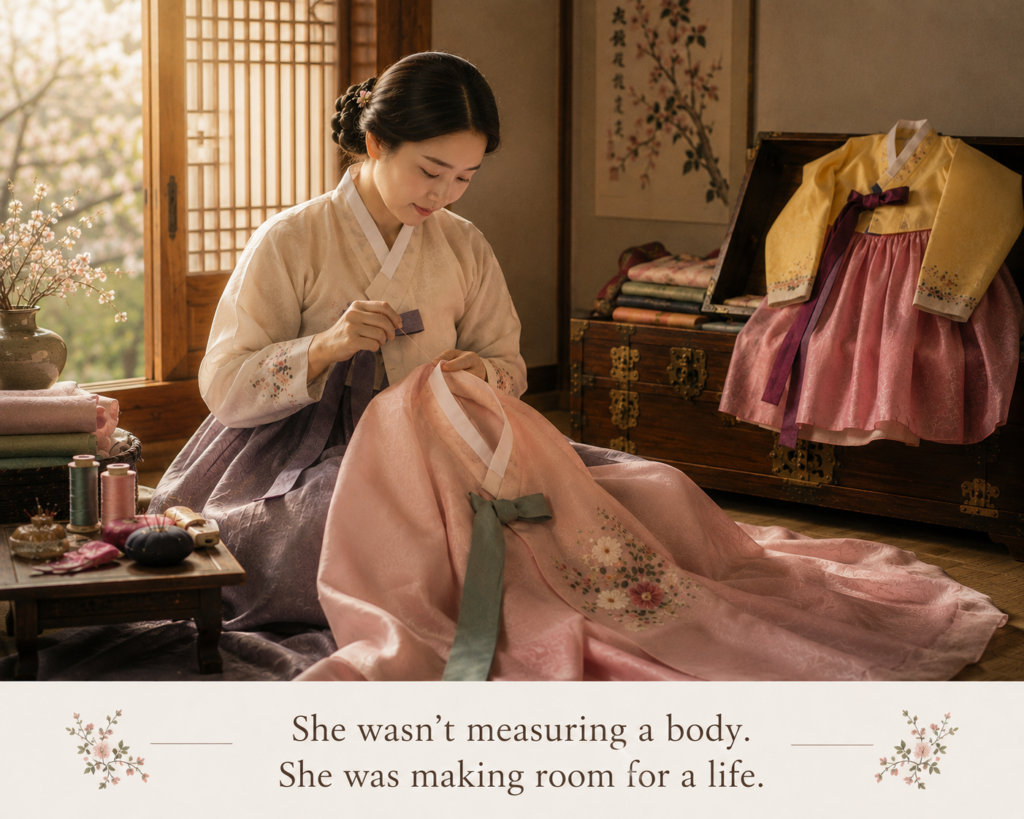
Years later, a grandmother opens a wooden chest and takes out the hanbok she carefully folded away long ago.
Time has changed her body.
Her shoulders bend more than they once did.
Her waist is not the same.
But the hanbok does not judge those changes.
It embraces her just as gently as it always has.
A garment tailored tightly to a single moment could never travel so faithfully through a lifetime.
Hanbok can accompany a person from the first tiny jacket worn as a newborn to the clothing worn in the later seasons of life.
Without complaint.
Without judgment.
Simply by making room.
Epilogue : Tying the Ribbon
Years passed.
The daughter became a mother herself.
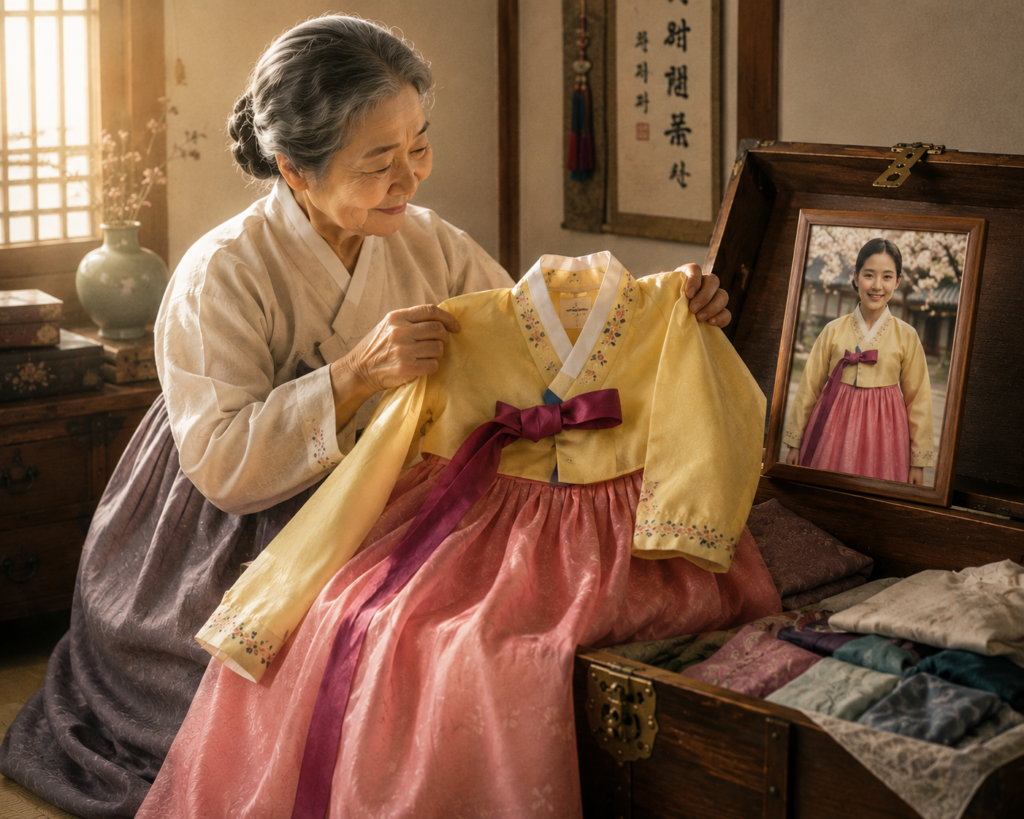
One evening, she placed a piece of fabric across her lap and pushed a needle through the cloth, just as her own mother had done years before.
Then, almost without warning, she heard those familiar words again.
“Clothes aren’t meant to fit the body. They’re meant to embrace it.”
Only now did she truly understand.
To make clothing fit the body perfectly is to preserve a single moment of beauty.
But to make clothing that embraces the body is to embrace every season of a person’s life—both the years already lived and those still to come.
She carefully tied the final ribbon.
The knot didn’t have to be perfectly symmetrical.
That wasn’t what mattered.
What mattered was the quiet space it left behind.
Perhaps that space was never meant for the garment at all.
Perhaps it was always meant for the person living inside it.
Author’s Note
The mother and daughter in this essay are not historical figures.
They represent the countless Korean mothers who, across generations, stitched more than clothing into a hanbok.
With every careful thread, they also passed down a way of seeing people—with patience, generosity, and room to grow.
Thank you for reading.
- If you’d like to keep exploring Korean culture, here are a few more essays.
https://open.substack.com/pub/jalboza/p/why-did-a-korean-king-create-hangul?r=8pkyc5&utm_medium=ios