Why Koreans Heat the Floor Instead of the Air
How Ondol Shaped Korea’s Homes, Culture, and Hearts
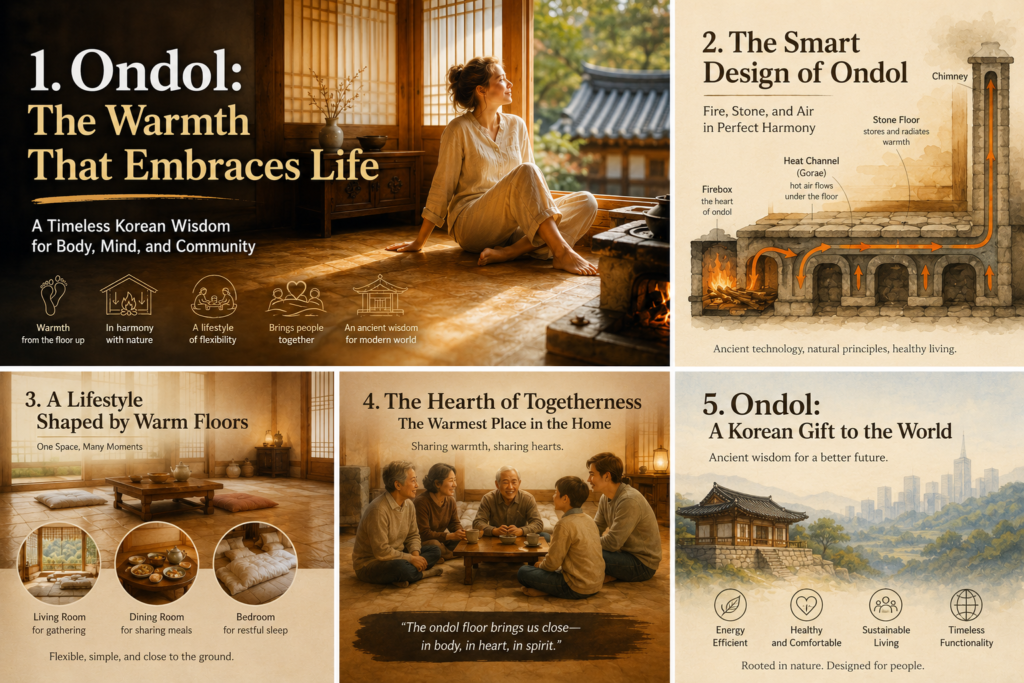
Imagine stepping into a home with no bed, no sofa, and no chairs.
For many first-time visitors to Korea, it feels almost empty. Then comes an unexpected invitation: take off your shoes.
As your bare feet touch the floor, something surprising happens.
Warmth rises gently beneath you.
Not from a fireplace.
Not from a heater blowing hot air.
It comes quietly from the floor itself.
That first sensation is often a foreigner’s introduction to one of Korea’s oldest inventions: ondol, the traditional underfloor heating system.
But ondol is more than a clever way to survive winter.
It is a way of thinking about comfort, home, and even human relationships.
Where Warmth Begins
Throughout history, many cultures learned to warm the air inside their homes. Fireplaces, wood stoves, and later radiators transformed cold rooms into livable spaces.
Korea asked a different question.
What if we warmed the person before we warmed the room?
The answer was beautifully simple.
Warm the floor.
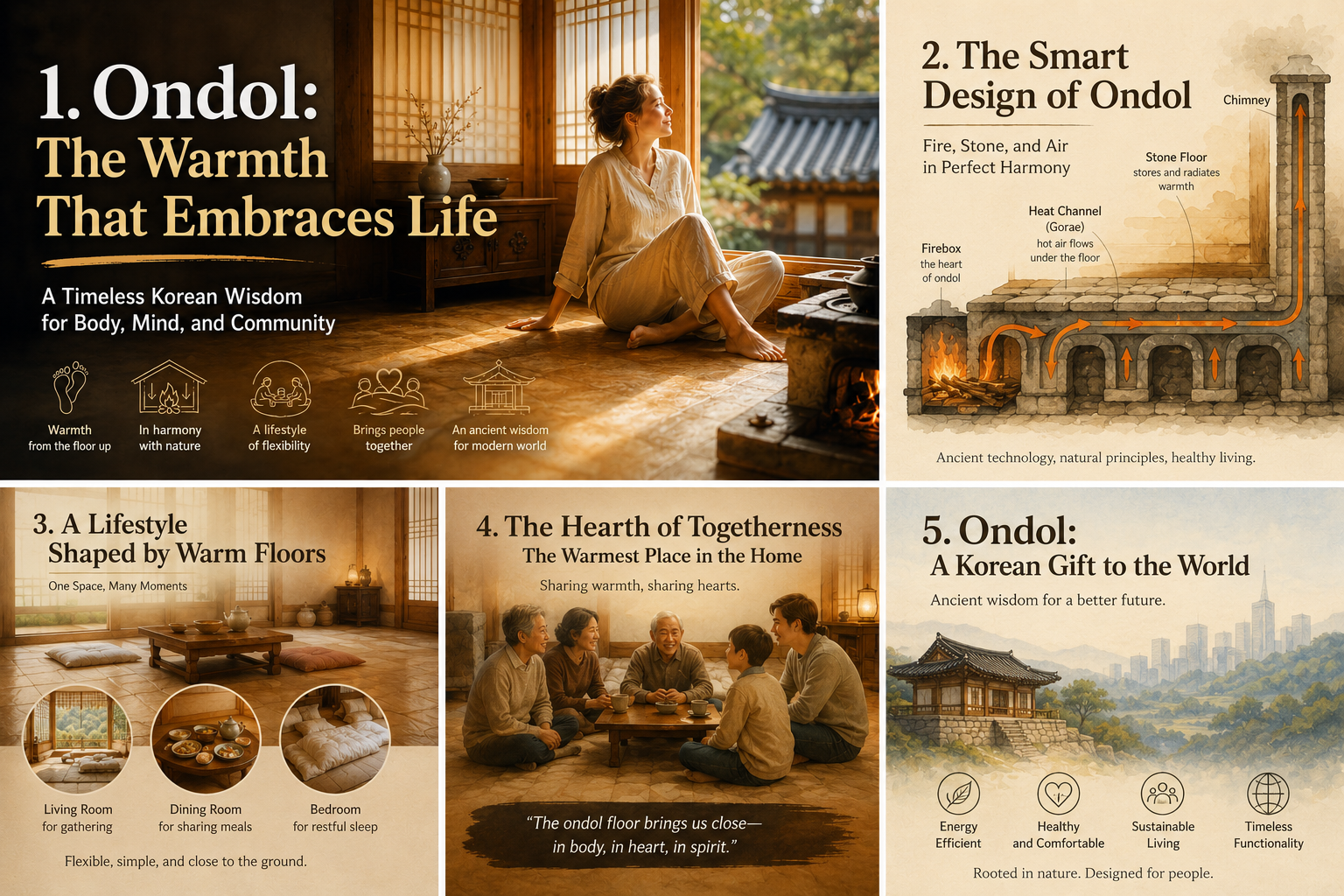
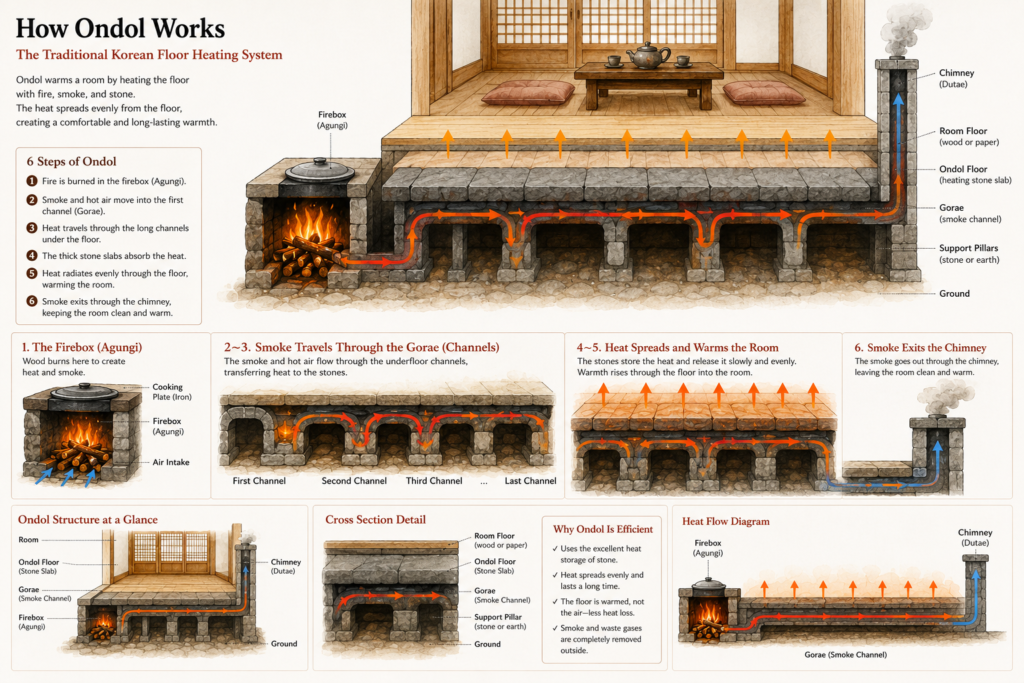
Beneath the room, fire burns inside a traditional firebox called the agungi. The hot smoke and heat travel through carefully built stone channels known as the gorae, passing underneath large stone slabs called gudeuljang. These thick stones slowly absorb the heat, store it, and release it evenly for hours.
By the time the smoke leaves through the chimney, the room remains quietly warm.
Instead of surrounding people with hot air, ondol allows warmth to rise naturally—from the ground, through the body, and into the heart.
Warmth begins beneath your feet.
That simple idea has shaped Korean life for centuries.
A House That Lives With You
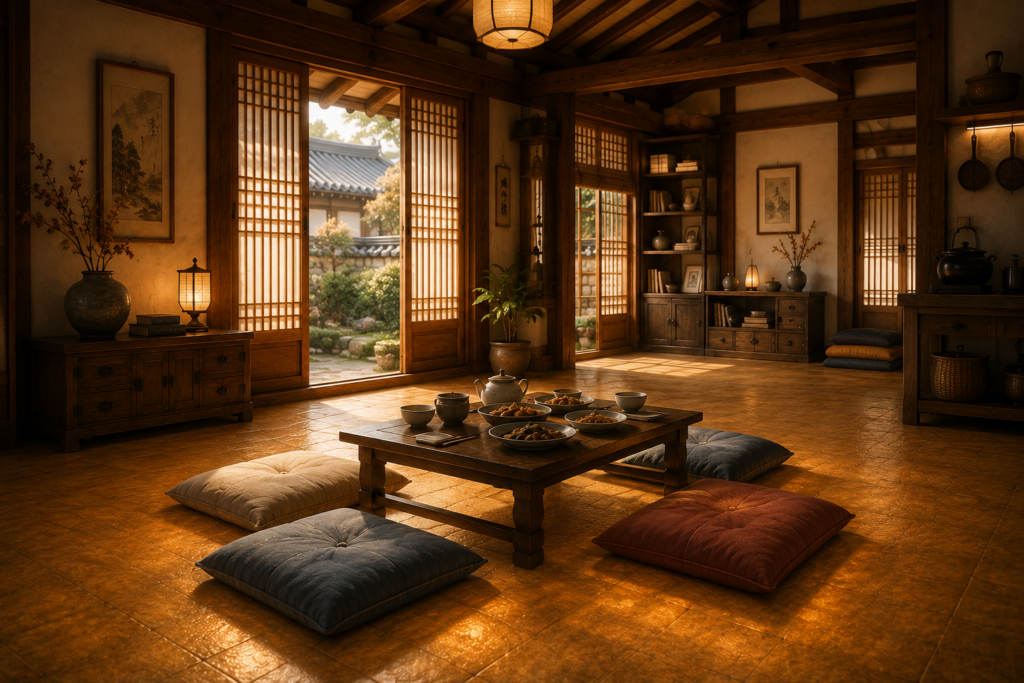
Once the floor becomes warm, the entire way people use a home changes.
The floor is no longer simply something you walk on.
It becomes where you sit.
Where you eat.
Where children play.
Where families gather.
Where guests are welcomed.
Where you sleep.
A single room transforms throughout the day.
Fold away the bedding, and it becomes a living room.
Bring out a small table, and it becomes a dining room.
Lay the bedding down again at night, and it becomes a bedroom.
Nothing about the space is fixed.
The room adapts to life instead of forcing life to adapt to the room.
Long before people spoke about minimalism or flexible living, Korean homes quietly practiced both.
The Warmest Place in the House
Every traditional ondol room had one special place.
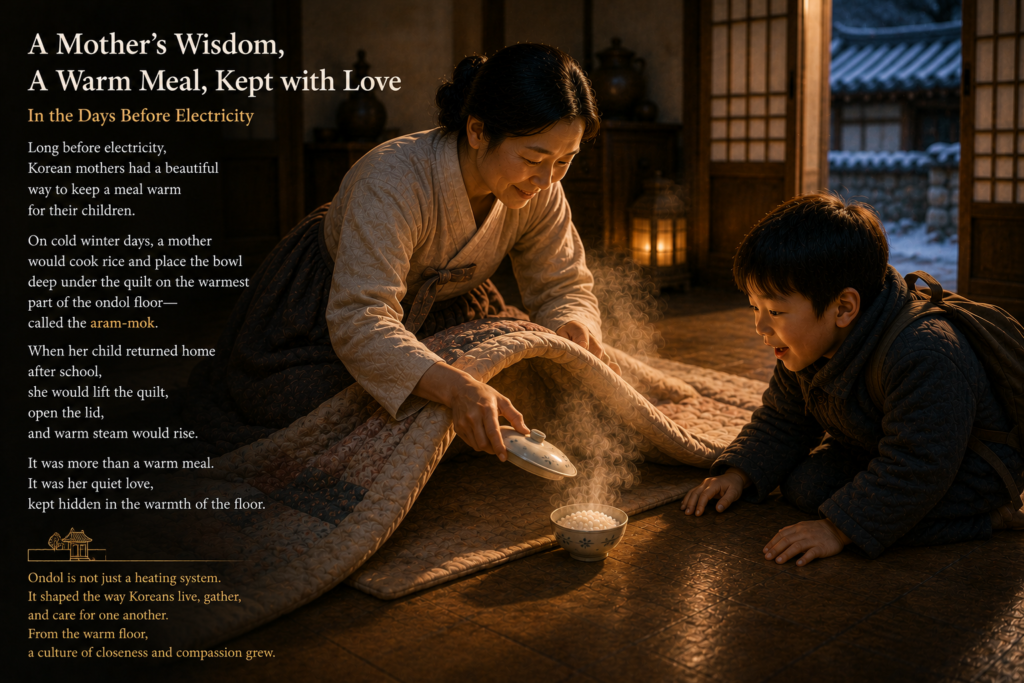
It was called the aram-mok—the warmest part of the floor, closest to where the heat first entered.
That spot was never just about temperature.
It was a place of honor.
The elderly rested there.
Parents returning home after a long day were invited to sit there first.
Guests were offered the warmest place without being asked.
Love often revealed itself not through words, but through where someone was invited to sit.
Many Koreans still remember another winter ritual.
Before children returned from school, mothers would wrap bowls of freshly cooked rice in cloth and tuck them beneath the blankets covering the warm floor.
Hours later, when a child lifted the blanket, warm steam still rose from the bowl.
For many Koreans, that memory carries the unmistakable feeling of home.
Warm Floors, Warm Hearts
In winter, families naturally gathered on the floor.
They shared meals.
They talked.
They laughed.
Sometimes they simply sat together in comfortable silence.
Of course, ondol alone did not create Korea’s sense of jeong—that uniquely Korean feeling of deep human affection and emotional connection.
Culture is always shaped by many forces.
Yet it is difficult to ignore how a home designed to bring everyone onto the same warm floor also encouraged people to spend more time together.
Perhaps architecture quietly teaches us how to live.
Perhaps warmth changes more than temperature.
Perhaps it also softens the distance between people.
A Gift That Still Warms the Modern World
Today’s Korean homes no longer rely on wood-burning fireboxes.
Modern boilers have replaced traditional systems, while preserving the same essential idea.
The warmth still begins from below.
And Koreans still instinctively remove their shoes before stepping inside.
Because comfort, for them, has never been something that blows across a room.
It is something that gently rises from beneath.
The first time I watch a foreign friend lie comfortably on a heated Korean floor—smiling without realizing why—I know they are experiencing more than a different heating system.
They are experiencing a different philosophy of home.
A philosophy that values the lowest place.
That works with nature rather than against it.
That quietly gathers people together.
In a world that grows faster, louder, and more divided every year, perhaps what we need most is not another technological breakthrough.
Perhaps we simply need a place where warmth begins beneath our feet and gently reminds us that home is where both the body and the heart are invited to rest.
And perhaps that is one of Korea’s warmest gifts to the world.
Every culture has its own way of creating warmth.
In Korea, that warmth has traditionally risen from the floor. Where does warmth come from in the homes you remember?
I would love to hear about a warm place—or a warm memory—from your part of the world.
Thank you for reading.
If these essays help you see the world a little differently, you can support my writing with a cup of coffee.
Every cup helps keep JALBOZA growing—one story at a time.
☕ Buy me a coffee
See Beyond the Net.
https://open.substack.com/pub/dalmaza/p/when-concepts-outlive-the-worlds?r=8pkyc5&utm_medium=ios