
Why Did a Korean King Create Hangul, Korea’s Alphabet?
The Love That Gave Ordinary People Their Own Voice

Prologue: A Letter That Could Not Be Written
Imagine being unable to write a letter to someone you love. Not because you have nothing to say — because the words in your heart have no letters of their own.
Now imagine living in fifteenth-century Korea.
A farmer’s daughter has married and moved far from home. He thinks of her often — while working in the fields, during his evening meal, in the quiet moments before sleep. One day, he decides to send her a letter.
He wants to ask how she is doing. Whether she’s been eating well. Whether her new life has been kind to her. Most of all, he wants to tell her how deeply he misses her.
But he cannot write a single character. He has never learned to read or write.
So he does what countless ordinary people of his time had no choice but to do: he finds someone literate and asks them to write it for him.
But some words are too personal to pass through another person’s mouth. How do you ask a stranger to write down love you’ve carried silently for years?
He begins to speak, but the words don’t come out as he’d imagined. Embarrassed, he leaves most of it unsaid. In the end, he manages only a few plain lines.
“Please tell her to take care of her health.”
The letter is finished. But the words he most wanted to send never reach the page.
This was the quiet tragedy for many ordinary people in fifteenth-century Korea. They had voices. They had stories. They had grief. They had hope. Speech was theirs. Writing was not. Thought was theirs. The means to preserve it belonged to someone else.
One king looked directly at that reality, and decided it had to change. What followed was not merely the creation of a new script — it was a reimagining of what writing could be, and whom it should belong to.
A Script That Lets You See Sound
If King Sejong wanted ordinary people to write, he could not simply simplify the existing system. He had to begin again.
At the time, Joseon’s educated elite wrote primarily with Chinese characters, known in Korea as hanja. These carried centuries of cultural authority, but mastering them required years of dedicated study — a luxury most farmers, laborers, women, and the poor simply did not have.
King Sejong asked a remarkable question: could a writing system be designed so clearly that ordinary people could learn it in days rather than years?
His answer was Hunminjeongeum — literally, “the correct sounds for the instruction of the people.” Even its name reveals whom the script was meant to serve.
According to the Hunminjeongeum Haerye, the official commentary explaining the principles of the script, a wise person could learn it before the morning was over, while even someone slow to learn could master it within ten days.
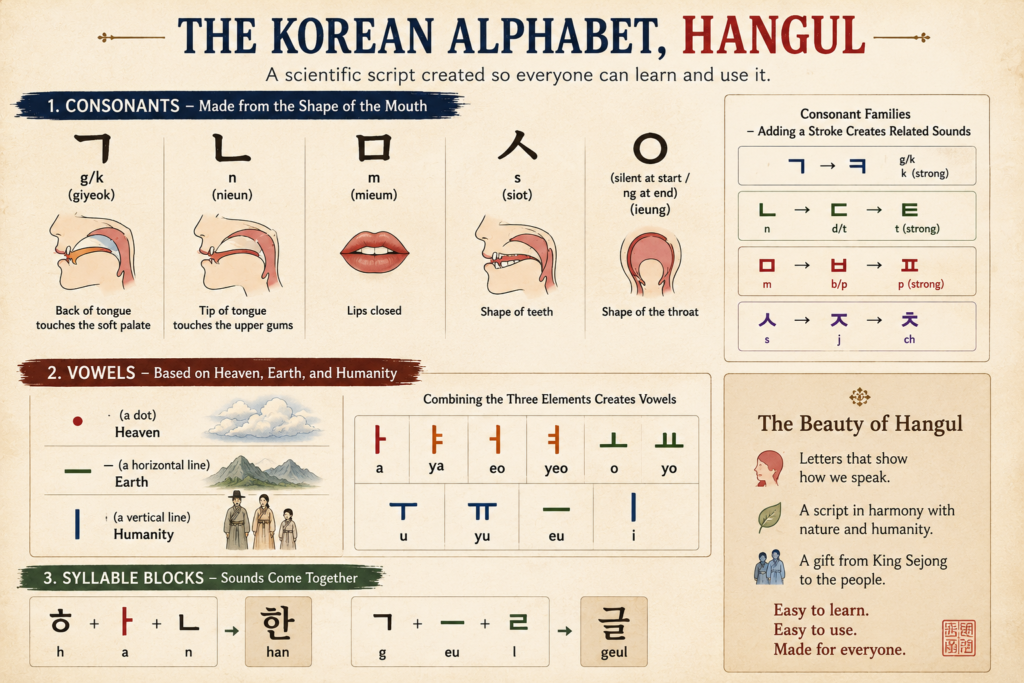
The answer lay inside the human mouth. Rather than inventing arbitrary symbols, King Sejong and the scholars who worked with him observed how speech is physically produced, and built the basic consonants as visual descriptions of the speech organs themselves:
ㄱ (g/k) reflects the back of the tongue rising toward the soft palate.
ㄴ (n) reflects the tongue touching the ridge behind the upper teeth.
ㅁ (m) reflects the shape of closed lips.
ㅅ (s) reflects the outline of a tooth.
ㅇ reflects the shape of the throat; silent at the beginning of a syllable, an “ng” sound at the end.
King Sejong then revealed the relationships between sounds by adding simple strokes to the basic forms: ㄱ became ㅋ. ㄴ gave rise to ㄷ, which became ㅌ. ㅁ gave rise to ㅂ, which became ㅍ. ㅅ gave rise to ㅈ, which became ㅊ. Rather than asking learners to memorize unrelated symbols, the script let them see how sounds belonged together.
The vowels rested on an equally elegant foundation: three simple elements — ㆍ representing Heaven, ㅡ representing Earth, ㅣ representing Humanity. From these three, the entire vowel system emerged.
The consonants describe the human body producing sound. The vowels express a vision of Heaven, Earth, and humanity in harmony. Even the syllable blocks reflect this — individual letters gather into balanced units, like 한 and 글, turning simple sounds into complete syllables.
Hangul works on several levels at once: a single letter shows how a sound is made, a family of letters shows how sounds relate, a syllable block shows how sounds become language. It is less a code to memorize than an idea to understand.
And that raises a deeper question: why would a king devote such extraordinary care to making writing accessible to everyone? The scientific brilliance of Hangul is undeniable — but science was never its final purpose. It was the means. To understand the heart of Hangul, we have to look past the shapes of its letters and ask why King Sejong wanted ordinary people to hold them.
Why Make It This Easy?
The problem in Joseon was never the absence of writing. It was the absence of access. The language of daily life belonged to the people; the written language of power did not.
That distance created something more painful than illiteracy — it separated people from their own voices. Speaking through another person’s brush is never quite the same as speaking for yourself. A private feeling must first be exposed to a stranger, and something essential is almost always lost along the way.
King Sejong understood this. His people were not silent because they lacked thoughts — they were silent because the tools of expression had been placed too far beyond their reach.
That is why Hangul had to be easy: not because ordinary people lacked intelligence, but because their words deserved to be written. Its simplicity was not a compromise — it was the moral center of the project, the thing every stroke, shape, and principle was quietly working toward: moving writing one step closer to those who had never possessed it before.
A King Who Saw the Person Behind the Letters
In the preface to the Hunminjeongeum, King Sejong explains why he created the script. In one widely used English translation, he writes:
“Our language differs from that of China, and so it does not match with Chinese characters. Because of this, many ordinary people who have something they wish to express are ultimately unable to make their meaning known.”
Notice what he does not say. He does not say his people lack intelligence, or that they have nothing worth expressing. He says they already have something they wish to say — they simply cannot write it.
He continues: “Moved by compassion, I have newly created twenty-eight letters.”
He saw the problem, felt for the people living it, and built something to fix it. Where power usually asks ordinary people to adapt themselves to elite systems, King Sejong reversed that relationship — he brought writing to the people.
His vision becomes unmistakable in the closing line of the preface: “My wish is simply that every person may learn it with ease and use it conveniently in daily life.”
Every person. Not merely scholars. Not merely officials. Those two words transform a writing system into an expression of human dignity — an answer to generations of silence: a father unable to write to his daughter, a woman unable to record an injustice, ordinary people whose thoughts disappeared because they had no way to preserve them. The scientific beauty of Hangul was the method. Human dignity was the reason.
The Letter That Finally Arrived
Years passed. The new script spread slowly — some scholars resisted it, and history rarely changes overnight. Yet little by little, Hangul entered ordinary homes. Mothers taught it to their children. Merchants kept records with it. Neighbors exchanged letters in their own language.
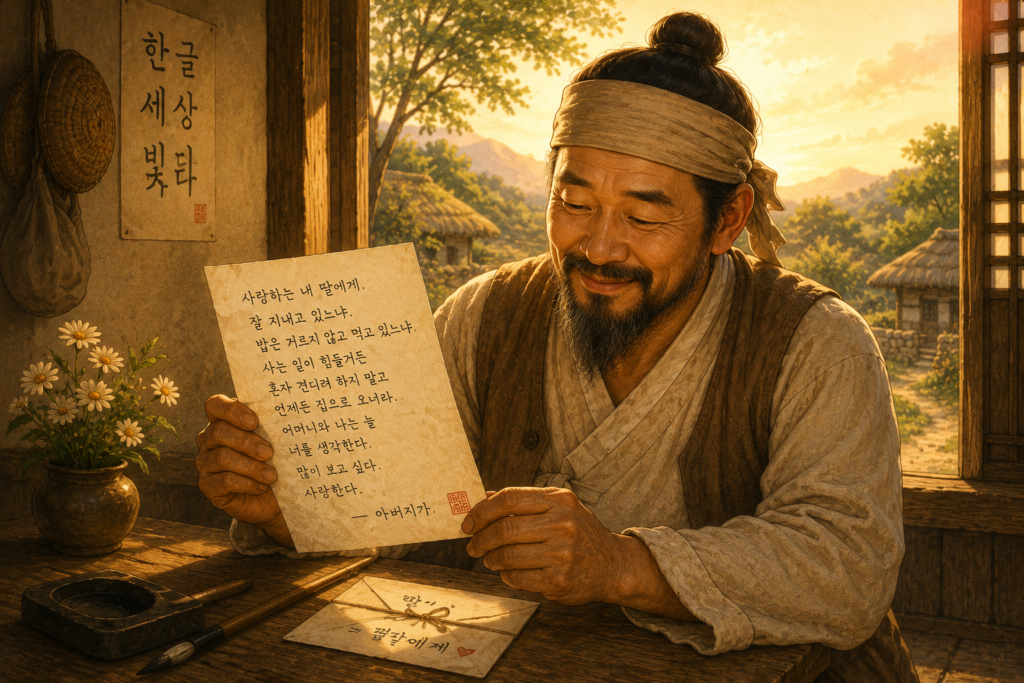
Among them, perhaps, was a father like the one with whom our story began. Now older, with rough hands worn by decades in the fields, he sits before a sheet of paper. His handwriting is clumsy, his strokes uneven. But for the first time in his life, none of that matters — because this time, the hand holding the brush is his own.
My beloved daughter,
I hope you are well.
Are you eating enough?
If life becomes difficult, do not carry your burdens alone.
Come home whenever you wish.
Your mother and I miss you very much.
I love you.
— Your father
At the bottom of the page, he signs his own name. Every word belongs to him — chosen by no one else, softened by no one else. The distance between his heart and his hand has finally disappeared.
He folds the letter carefully. Not because it is beautifully written. But because it is finally, completely, his.
Epilogue: The Day a King Gave His People Their Own Voice
In 1446, Hunminjeongeum was proclaimed to the world.
Today, Hangul is celebrated as one of the world’s most remarkable writing systems. Linguists admire its logical design. Designers admire its elegance. Students marvel at how quickly it can be learned. All of this praise is deserved.
But if we remember Hangul only for its scientific brilliance, we overlook the deepest reason it exists. Science explains how Hangul was made. Compassion explains why: King Sejong believed that every human being possesses a voice worth preserving, and that no one should have to borrow another person’s hand to write what is in their own heart.
The paper of that nameless father’s letter has long since disappeared — its ink faded, its words lost. But its meaning remains. Hunminjeongeum was never merely the birth of a writing system. It was the day writing was returned to ordinary people — the freedom to write the words of their own hearts.
Author’s Note
The farmer and his daughter in this essay are symbolic figures, not specific historical individuals. They represent the countless ordinary people of fifteenth-century Korea whose thoughts, hopes, and love often remained unwritten because they lacked a writing system they could easily call their own.
Thank you for reading.
If these essays help you see the world a little differently, you can support my writing with a cup of coffee.
Every cup helps keep JALBOZA growing—one story at a time.Buy me a coffee