What Rock, Paper, Scissors Revealed About How We See Reality
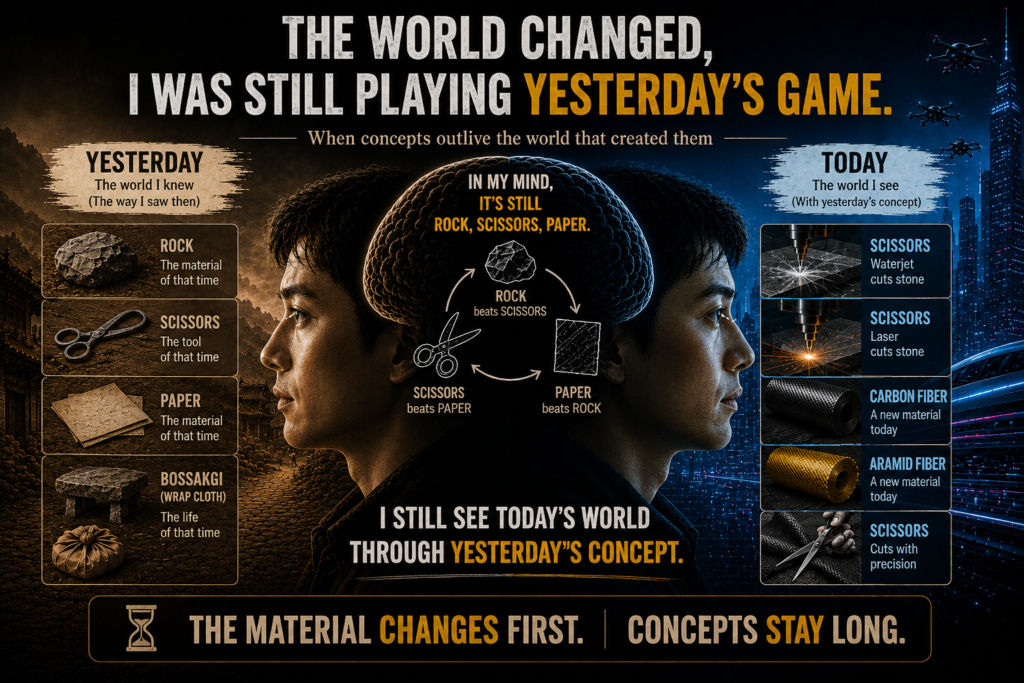
There are ideas we learn so early in life that we never think to question them.
Not because they have been proven true.
But because they have always been there.
For most of us, they become part of the background of reality itself.
A question stopped me not long ago.
Are yesterday’s scissors the same as today’s scissors?
At first, it sounded almost ridiculous.
Scissors are scissors.
Paper is paper.
Rock is rock.
Or so I assumed.
Then I realized the question was never really about a children’s game.
It was about the way we understand the world.
Rock.
Paper.
Scissors.
Three simple gestures.
Three unquestioned rules.
Rock crushes scissors.
Scissors cut paper.
Paper covers rock.
As children, those rules felt as certain as gravity itself.
A pair of steel scissors could never cut through a rock.
A sheet of paper could never survive a sharpened blade.
The game felt permanent because the physical world that inspired it also seemed permanent.
Looking back, I realize I was confusing familiarity with truth.
The rules were never eternal.
They only reflected the material world of their time.
Then the material world changed.
Today’s scissors are no longer limited to sharpened steel.
Industrial lasers slice through solid granite with astonishing precision.
Ultra-high-pressure waterjets carve stone using nothing but water.
Suddenly, scissors cut rock.
Paper changed too.
Carbon-fiber composites.
Aramid fibers.
Advanced engineered materials.
Some are so resilient that ordinary blades barely leave a scratch.
Sometimes the scissors fail before the material does.
Now paper defeats scissors.
At first, I thought this was simply another story about technological progress.
It wasn’t.
It was a story about concepts.
For centuries we assumed that rock defeated scissors because stone was harder than steel.
But that rule was never a universal law.
It emerged from the material properties available at a particular moment in history.
When materiality changed…
the rule changed with it.
That realization forced me to ask a far more unsettling question.
How many of the concepts I still live by belong to a world that no longer exists?
Perhaps this is how every civilization becomes outdated.
Not because reality refuses to change.
But because its concepts refuse to.
We do not live by the physical properties of things alone.
We live by the concepts we build to make sense of those properties.
Over time, concepts harden into rules.
Rules become language.
Language becomes culture.
And culture quietly becomes perception.
Eventually, we stop seeing reality directly.
Instead, we see reality through concepts that once described it well.
That is why concepts often outlive the worlds that created them.
The physical world evolves first.
Our conceptual world follows much later.
Sometimes generations later.
Consider the way we still speak about work.
We say we are “going to work,” as though work were a destination rather than an activity.
Yet millions of people now build companies, write books, design products, create films, teach classes, and lead international teams without ever commuting to an office.
The reality changed.
Our language remained.
Education tells a similar story.
For centuries, knowledge was scarce.
Memorization made sense.
Remembering information was a genuine competitive advantage.
Today, information has become one of humanity’s most abundant resources.
Artificial intelligence retrieves, organizes, compares, and synthesizes knowledge faster than any individual can.
The value has shifted.
Remembering matters less.
Asking meaningful questions matters more.
Yet many educational systems continue measuring yesterday’s strengths for tomorrow’s world.
Wealth reveals the same pattern.
Industrial society rewarded visible assets.
Land.
Factories.
Buildings.
Machines.
Today, invisible assets quietly shape the global economy.
Software.
Networks.
Algorithms.
Data.
Ideas.
The foundations have changed.
Our instincts often have not.
This pattern appears so frequently that it no longer seems accidental.
Perhaps history moves twice.
First, reality changes.
Only later do concepts catch up.
And in the space between those two movements, confusion becomes inevitable.
Perhaps this explains why every great revolution feels so unsettling.
The hardest part is rarely learning something new.
More often, it is letting go of something that once described reality perfectly.
Concepts do not disappear when reality changes.
They linger.
They survive inside language.
Inside institutions.
Inside traditions.
Inside habits.
And, most powerfully, inside the way we perceive the world.
That is why every generation inherits more than knowledge.
It inherits a way of seeing.
Most of the time, that inheritance is a gift.
Sometimes, however, it becomes a prison.
Not because it is false.
But because it continues answering questions that reality is no longer asking.
Perhaps this is why history often surprises us.
Reality changes quietly.
Concepts change reluctantly.
By the time we realize the distance between them, we call it a revolution.
But revolutions do not begin when new technology appears.
They begin when old concepts stop describing reality.
Technology is only the visible symptom.
The deeper transformation happens beneath it, where our assumptions about the world slowly lose their power.
We often imagine that progress comes from inventing better tools.
Perhaps it comes just as much from abandoning obsolete concepts.
The challenge, then, is not simply to innovate.
It is to perceive.
To notice when the world has already become something different.
To recognize when yesterday’s categories have quietly stopped explaining today’s reality.
That may be one of the greatest responsibilities of every generation.
Not merely to create new ideas.
But to discover which old ideas have quietly reached the end of their lives.
Before asking whether you are holding a rock, a sheet of paper, or a pair of scissors, perhaps there is another question worth asking.
Am I seeing reality itself, or only the concepts I inherited to describe it?
Perhaps the rock I fear is no longer the strongest thing in the game.
Perhaps the scissors I dismiss have become something entirely different.
Perhaps the paper I still think of as fragile has quietly evolved into something stronger than steel.
The point is not that rock, paper, and scissors have changed.
The point is that materiality changed, and the concepts built upon it failed to keep pace.
When concepts outlive the worlds that created them, they slowly stop revealing reality.
Instead, they begin to conceal it.
The future rarely announces its arrival.
It enters unnoticed, wearing the ordinary face of today.
Most people believe the world changed overnight.
It rarely does.
Reality has usually been changing for years.
What arrived late were our concepts.
Perhaps wisdom is not the ability to defend yesterday’s answers.
Perhaps wisdom begins with the courage to ask whether yesterday’s questions still belong to today’s world.
Because the greatest revolutions are not merely technological.
They are conceptual.
And perhaps the most dangerous illusion is not believing something false.
It is believing that yesterday’s way of seeing is still enough to understand today’s reality.