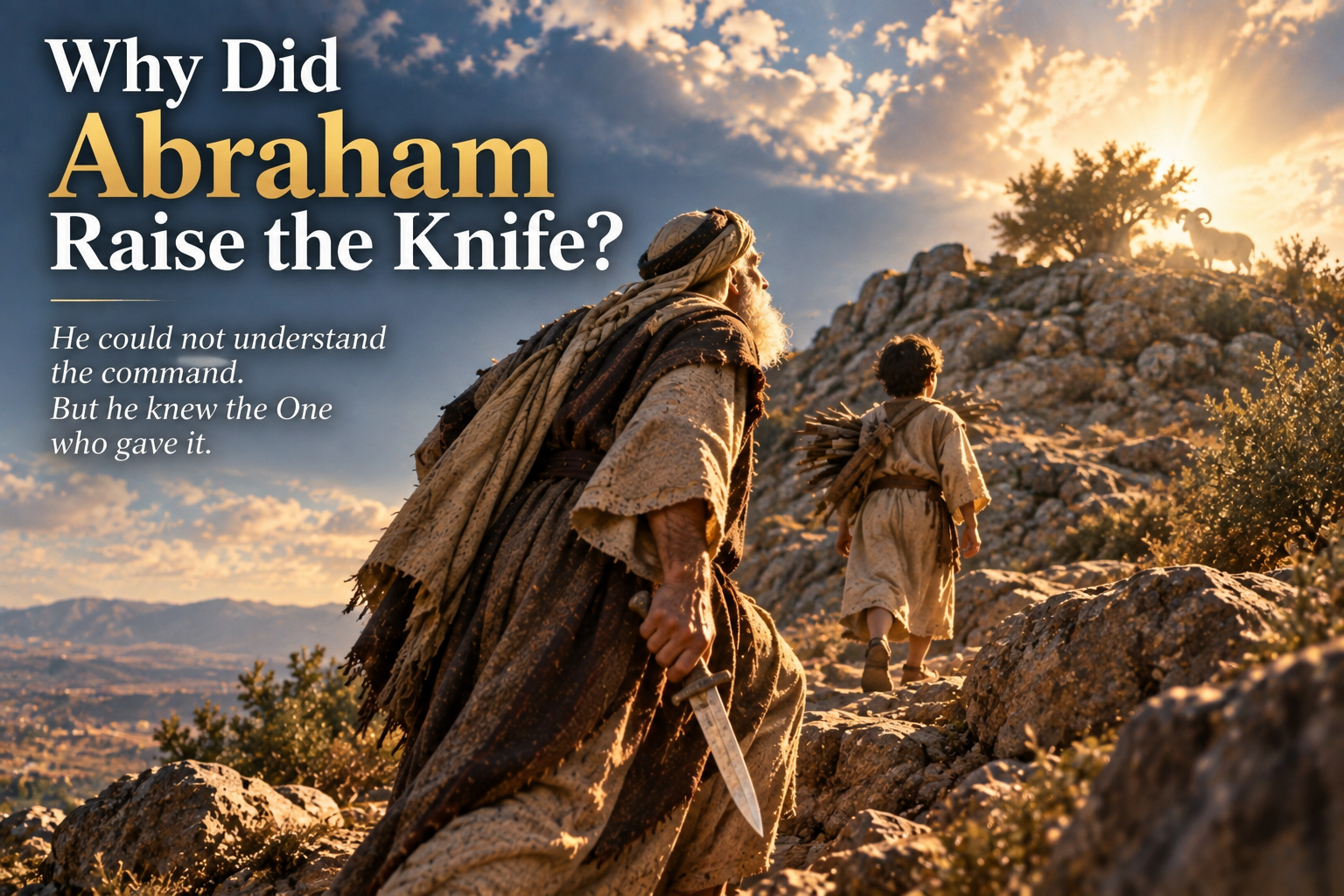
Why Did Abraham Raise the Knife?
1. A Choice Reveals What Faith Has Become
2. Remember the Story You Have with Heaven
.
People often ask: Why would God test a human being this way?
To us, a test like this can feel almost like a trap—something placed in our path to make us fall. In fact, that is how many people imagine divine testing: God sets the trap, then waits to see whether we step into it.
But what if that is not what is happening at all?
What if God is not setting a trap to destroy us, but standing quietly at the edge of an impossible contradiction, watching to see what conclusion we will reach?
There are moments when reason can take us no farther. Moments when everything we know seems to lead us to the edge of a cliff.
Abraham once stood at such an edge.
What conclusion was he struggling toward as he walked those three long days to Moriah?
Let us follow him.
Not merely to the moment when he raised the knife, but through the three days that brought him there.
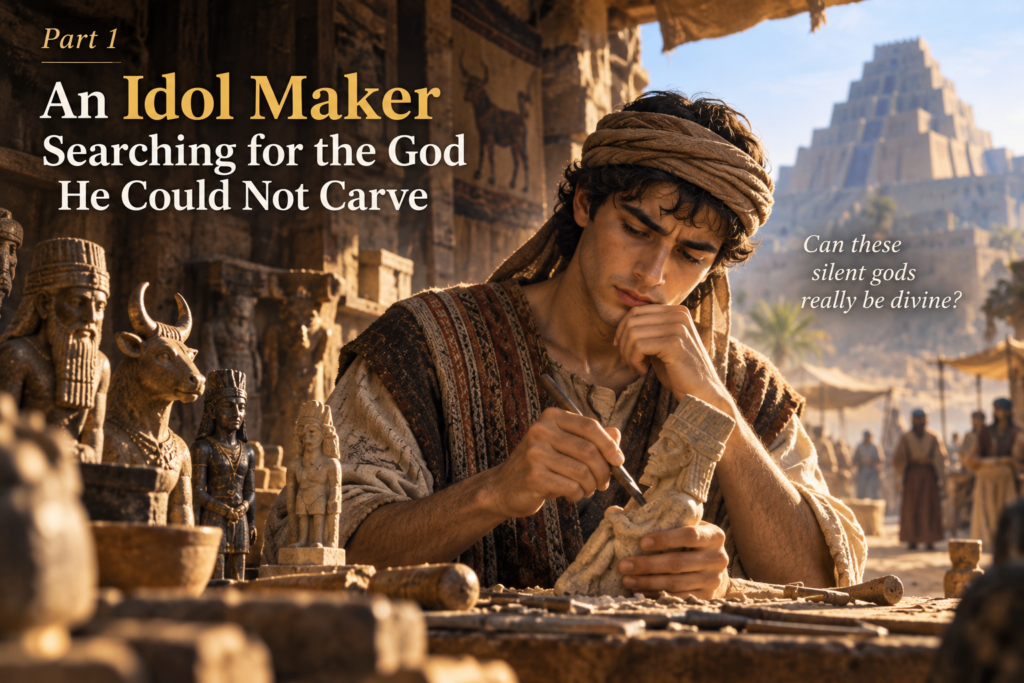
Part One: An Idol Maker Searching for the God He Could Not Carve
Abraham was not born the great “father of faith.”
Beyond the Euphrates, amid the dust and smoke of Ur of the Chaldeans, he was simply a man living in a world crowded with gods.
His family made and sold idols. Following the trade of his father, Terah, Abraham would have spent his days shaping wood and carefully working stone.
Perhaps one day a customer came to him and said,
“Make me an image of the moon god, something I can bow down to.”
And perhaps Abraham looked at the wood in his hands and wondered:
How am I supposed to put divinity into this?
There is a strange irony here.
Perhaps Abraham’s longing for the true God began precisely while he was making false ones.
As he shaped one god after another, he may have found himself asking:
Can these things that cannot speak or move really hold the power of life and death?
Perhaps in the quiet hours before dawn, the young Abraham was already beginning to look beyond everything his hands could make.
Toward an unseen source.
Toward a God who could not be carved from wood or stone.
Part Two: A Strange Voice, and the Slow Growth of Trust
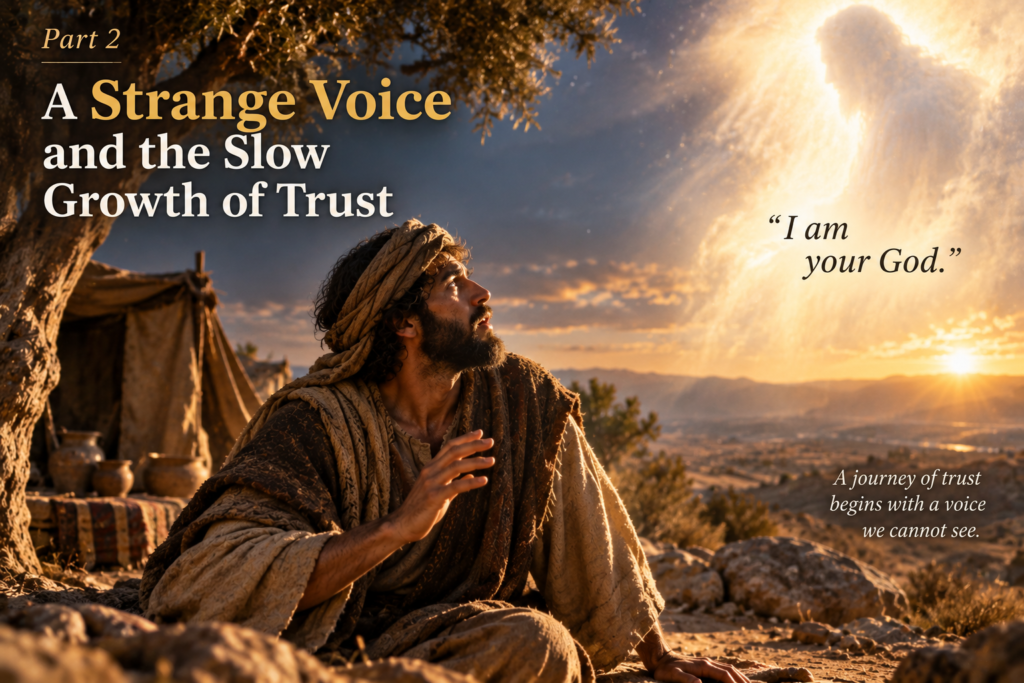
Then, one morning, a voice unlike any Abraham had ever heard entered his life.
“I am your God.”
At first, this God must have seemed utterly strange.
But relationships are not built in a moment.
Scripture compresses years into a few lines, but human beings do not experience life that way. For Abraham, trust would have accumulated slowly, one encounter at a time.
Each time that strange voice became something real in his life, another stone was laid in the foundation of trust.
Perhaps I can trust this God.
And when the command finally came—
“Leave your country, your relatives, and your father’s household”—
Abraham must have had a thousand reasons to hesitate.
Yet by then, something had already been built within him.
There was a history between them.
And the weight of that history was enough to move his feet.
So Abraham stepped away from everything familiar and walked into a wilderness without a map.
Part Three: The School of the Wilderness and the Laughter of a Hundred-Year-Old Man
The journey was not easy.
Abraham faltered in the face of famine. Out of fear, he lied about Sarah and called her his sister. He struggled through conflict with his nephew Lot.
Yet through every failure, every fear, and every uncertain step, he was learning who God was.
This was not the story of a flawless saint.
It was the story of an imperfect man who kept wavering—and kept growing.
Then came another moment when promise collided with common sense.
Abraham was nearly a hundred years old. Sarah had long passed the age of childbearing.
Yet God promised them a son.
Abraham did not need modern science to know how impossible that sounded. A lifetime of human experience was enough.
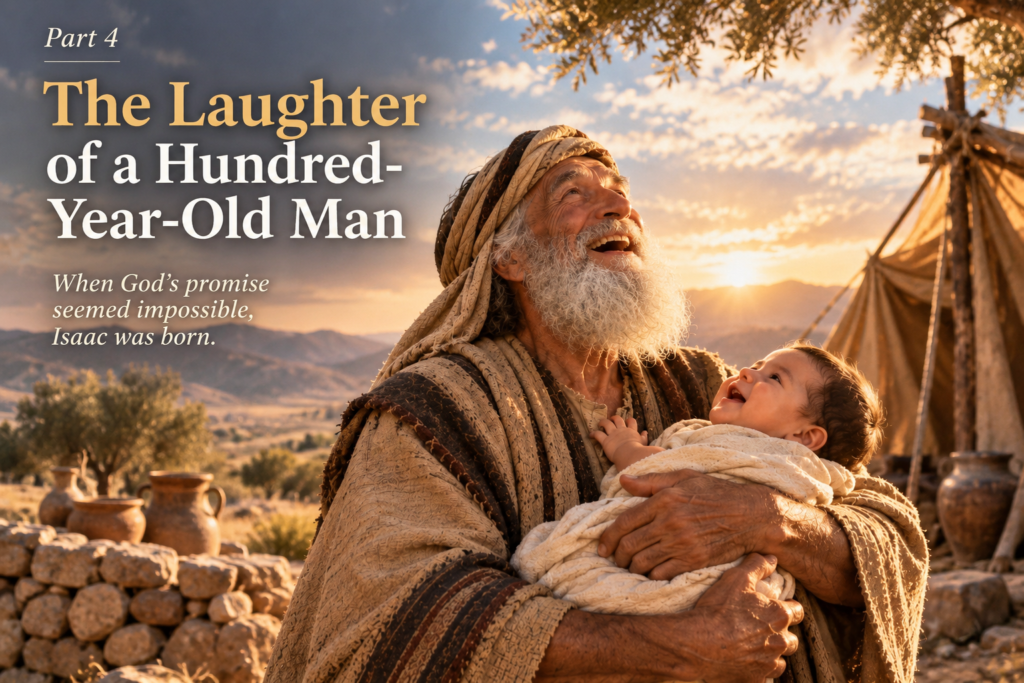
And yet, where human possibility ended, Isaac was born.
Isaac—whose very name means laughter.
At a hundred years old, Abraham held the impossible in his arms.
And perhaps something settled deep within him then:
So this is who You are.
You are not confined by the boundaries of what I think is possible.
The God who had made the promise had kept it.
Abraham had come to know the God who keeps His word.
Part Four: Three Days of Agony—and the Final Choice
Then came the command that seemed to contradict everything Abraham had learned.
Offer Isaac—the son given to him at a hundred years old—as a sacrifice.
For three days Abraham walked toward Moriah.
What must have passed through his mind?
Perhaps the first question was unavoidable:
Did I really hear God correctly?
And then another:
You said the promise would continue through Isaac. If Isaac dies, what happens to the promise?
The two words of God seemed impossible to hold together.
Through Isaac, your descendants will come.
And yet:
Offer Isaac.
No matter how Abraham turned them over in his mind, they seemed to contradict each other.
But somewhere along that three-day road, perhaps the question itself began to change.
Instead of asking,
Why would God command this?
Abraham may have begun asking something older:
Who is the God who has been walking with me all these years?
And then the memories would have returned.
The God who had called him away from home.
The God who had not abandoned him when he stepped into the unknown.
The God who had not withdrawn His promise when Abraham failed.
The God who, when every human possibility seemed exhausted, had placed Isaac in the arms of a hundred-year-old man.
And the God giving this incomprehensible command was the same God.
At last, Abraham stood on Mount Moriah and raised the knife.
Not because he finally understood the command.
Even after three days, it remained beyond the reach of human reason.
But although Abraham could not understand the command, he knew the One who had given it.
So Abraham chose to trust the God who had walked with him all those years more than he trusted his own understanding.
And he raised the knife.
Epilogue: For Those of Us Walking Our Own Road to Moriah
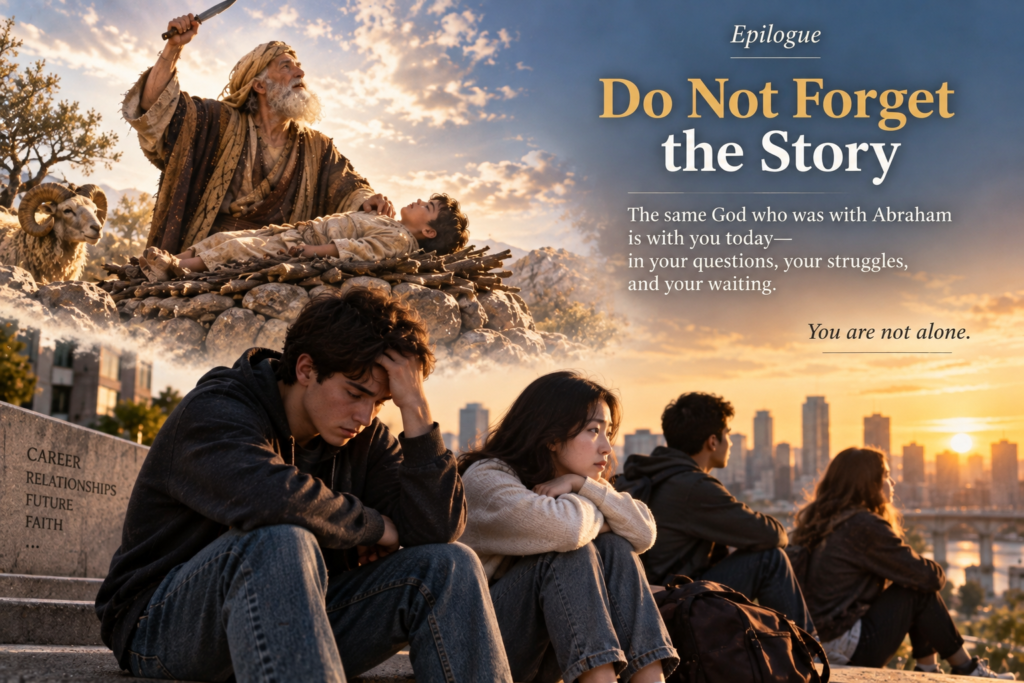
Abraham could stand at that incomprehensible edge because he carried with him the memory of decades spent walking with God.
There had been famine.
There had been waiting.
There had been his own mistakes and failures.
Yet through all of it, Abraham had slowly come to know one thing:
who God was.
If this is the One who has led me all this way, then perhaps I can trust Him even here, in a place I cannot understand.
A choice does not create faith in a single moment.
A choice is the moment when the faith built over many years finally reveals itself.
The answer Abraham found during those three days was not an answer to the question:
Why would God command such a thing?
Instead, he returned to an older question:
Who is the God who has been walking with me all these years?
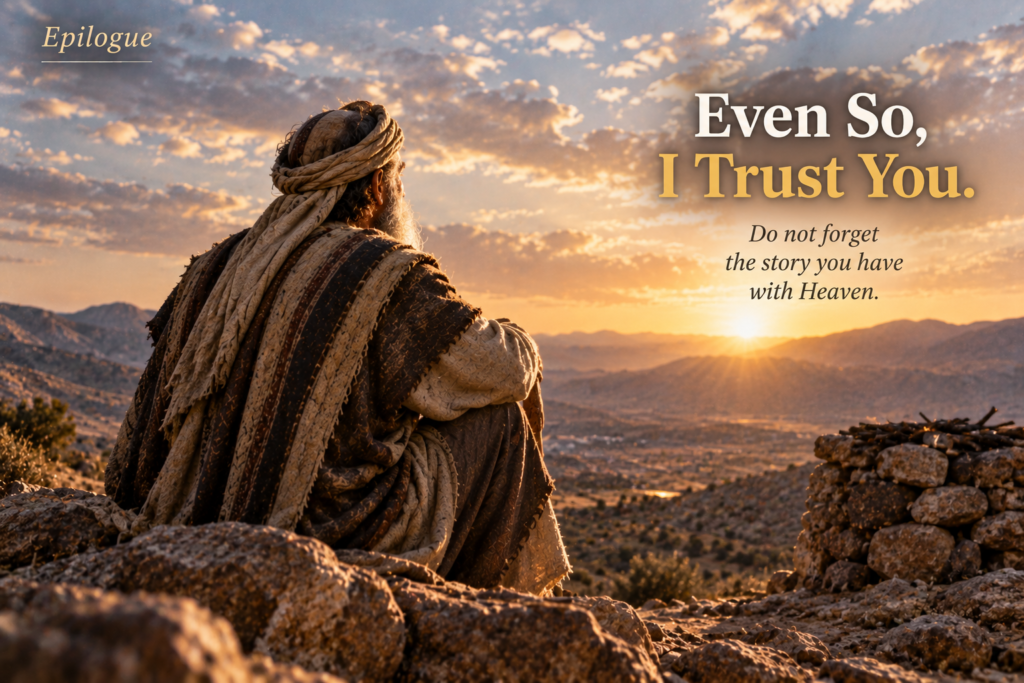
Do not forget the story you have with Heaven.
And at the end of that long story, perhaps Abraham finally knew what his choice would be:
Even so,
I trust You.